
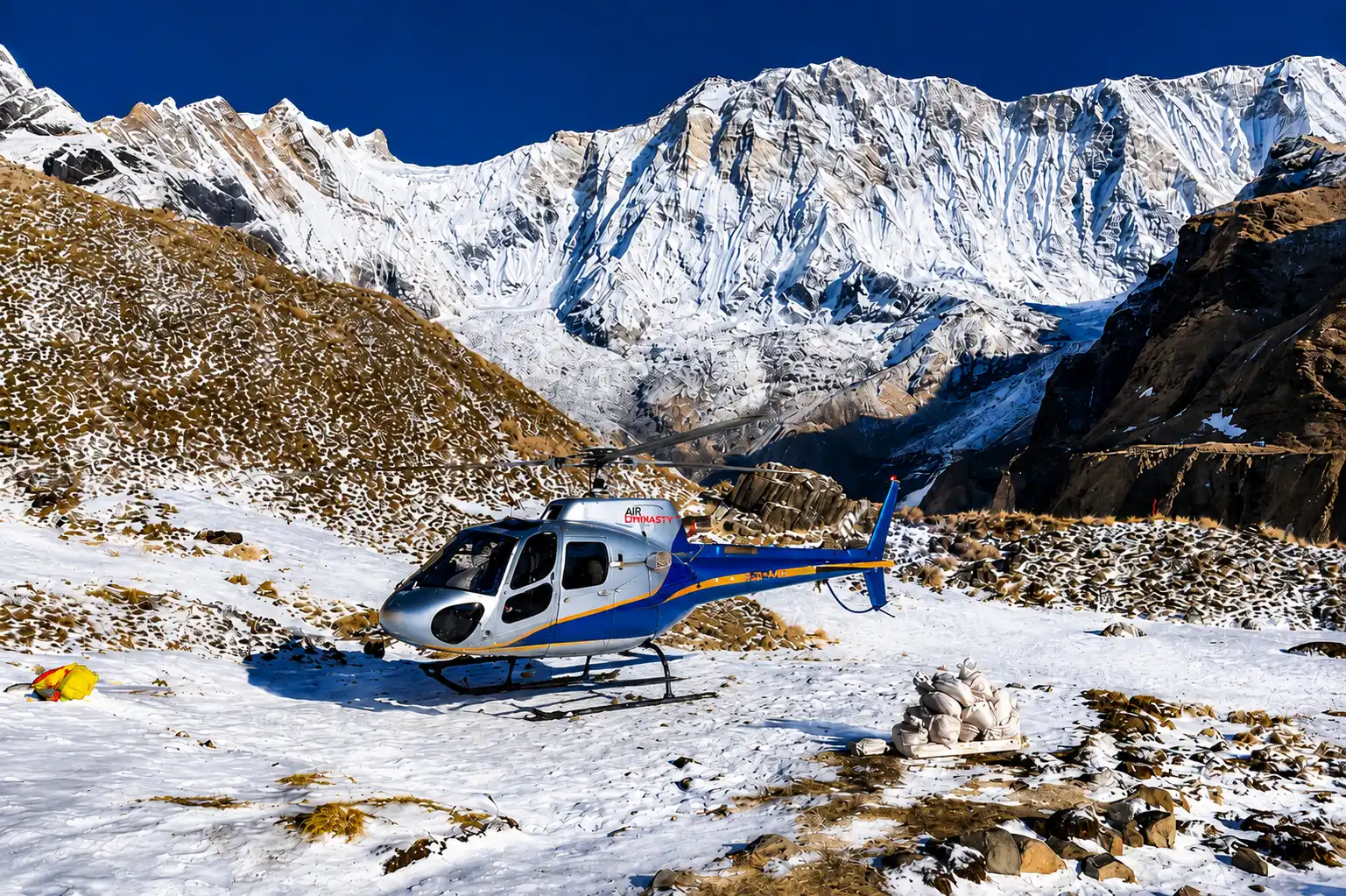
Standing at Annapurna Base Camp with towering Himalayan peaks rising around you is an experience that many travellers spend a week or more trekking to reach. With an Annapurna Base Camp helicopter tour, you can experience this spectacular mountain destination in just a few hours, without committing to a multi-day trek.
The Annapurna region continues to attract travellers from around the world with its dramatic mountain scenery, traditional villages, diverse landscapes, and famous trekking routes. Annapurna Base Camp sits at approximately 4,130 metres above sea level, surrounded by some of the most impressive peaks in the Himalayas.
Reaching Annapurna Base Camp on foot traditionally takes around 7 to 10 days, depending on the itinerary and starting point. The journey takes trekkers through destinations such as Ghandruk and Chhomrong before entering the dramatic Annapurna Sanctuary. While the trek offers an unforgettable experience, not every traveller has enough time for a multi-day Himalayan adventure.
That is where a helicopter tour offers a convenient alternative. You can fly directly toward the Annapurna Sanctuary, enjoy breathtaking aerial views of the mountains and valleys, land at Annapurna Base Camp, and return to Pokhara within the same day. The experience allows you to spend less time travelling and more time enjoying the Himalayas.
At Annapurna Heli Tours, we help travellers experience the Annapurna Sanctuary from the sky, from first-time visitors discovering Nepal to experienced trekkers looking for a faster and more comfortable way to reach Annapurna Base Camp. We understand that a helicopter tour is more than just a flight. It is an opportunity to make the most of your time in Nepal while enjoying spectacular Himalayan scenery in comfort and with safety as a priority.
This guide covers everything you need to know before booking an Annapurna Base Camp Helicopter Tour, including the flight experience, cost, itinerary, best time to visit, safety, permits, departure options, and helicopter tour versus trekking.
What Is an Annapurna Base Camp Helicopter Tour?
An Annapurna Base Camp Helicopter Tour is a scenic flight that takes you from Pokhara deep into the Annapurna Himalayas, giving you the chance to experience one of Nepal’s most spectacular mountain destinations without spending several days on the trail. The helicopter flies over green hills, mountain villages, deep valleys, and rugged Himalayan landscapes before reaching Annapurna Base Camp at about 4,130 metres (13,550 feet).
Once you arrive at base camp, you can step out, take in the incredible views, and capture photographs surrounded by towering peaks such as Annapurna South, Annapurna I, Hiunchuli, and Machhapuchhre (Fishtail). After spending a short time at the high-altitude landing area, you fly back to Pokhara, making it possible to enjoy the Annapurna experience within a single day.
This tour is especially popular with travellers who have limited time in Nepal, families, couples, and anyone who wants to see the Himalayas without committing to a demanding multi-day trek. It combines the thrill of a mountain flight with the comfort and convenience of reaching Annapurna Base Camp by helicopter.
Why Travelers Choose the Helicopter Over the Trek
The trek to Annapurna Base Camp is one of the best short treks in Nepal, but it demands 7 to 10 days and requires more time, a reasonable fitness level, and flexibility. An ABC Heli Tour offers breathtaking views and a convenient way to experience the same destination in just a few hours..
Here's what you gain by flying instead of walking:
- Reach Annapurna Base Camp in hours, not days: You can experience the base camp without committing a week or more to a trekking itinerary.
- See the Annapurna Sanctuary from above: The helicopter gives you a bird’s-eye view of valleys, ridges, glaciers, forests, and mountain villages that look completely different from the trail.
- Land at around 4,130 metres: Step out at Annapurna Base Camp and take in the dramatic amphitheatre of snow-covered peaks surrounding you.
- Skip the long days of high-altitude hiking: This makes the experience appealing to travellers who have limited time or prefer a more comfortable way to explore the Himalayas.
- Choose shared or private options: Depending on availability, you can select a shared flight for better value or a private charter for greater privacy and flexibility.
- Save time for the rest of Nepal: Instead of spending several days trekking, you can use the extra time to explore Kathmandu, Chitwan, Pokhara, Everest, or other destinations.
What the Flight Actually Looks Like
Leaving Pokhara Behind
The helicopter lifts off from Pokhara Airport and begins to ascend north. In the first few minutes, you'll keep gazing down at Phewa Lake and the city's rooftops. That view changes fast: terraced hillsides give way to rhododendron forests, then to bare alpine ridgelines as the aircraft gains altitude toward the Annapurna Sanctuary.
Landing at Annapurna Base Camp
This is the moment the entire tour builds toward: touching down at approximately 4,130 metres, encircled by Annapurna I, Annapurna South, Machhapuchhre, and Hiunchuli. Exactly where and how long you stay on the ground depends on weather, aviation regulations, and conditions on the day. Your pilot makes the final decision based on safety and actual flight conditions.
The Peaks You Can See
Mountain visibility varies with weather, season, and cloud cover. On a clear flight, you may see several major peaks of the Annapurna range:
| Peak | Elevation |
|---|---|
| Annapurna I | 8,091 m |
| Annapurna III | 7,855 m |
| Annapurna IV | 7,525 m |
| Gangapurna | 7,455 m |
| Annapurna South | 7,219 m |
| Machhapuchhre (Fishtail) | 6,993 m |
| Hiunchuli | 6,441 m |
Machhapuchhre, commonly known as Fishtail, is especially easy to recognise because of its distinctive double summit and striking shape.
Photography at Altitude
The light at Annapurna Base Camp is a spectacular setting for photography, with towering peaks, glaciers, snow-covered slopes, and dramatic mountain scenery surrounding you. Morning flights are often a popular choice for photography because mountain visibility can be better before clouds develop later in the day. However, conditions in the Himalayas can change quickly, so clear views are never guaranteed. Your actual visibility will depend on the weather, cloud cover, and conditions on the day of your flight.
Typical Annapurna Base Camp Helicopter Tour Itinerary from Pokhara
A typical Annapurna Base Camp helicopter tour from Pokhara follows this general sequence, although the exact schedule can vary depending on weather, airport procedures, flight operations, and your package:
- Hotel pickup in Pokhara (if included)
- Transfer to Pokhara Airport
- Check-in and pre-flight briefing
- Departure toward the Annapurna Sanctuary
- Scenic flight over the Annapurna foothills
- Landing at Annapurna Base Camp
- Ground time for photos and mountain viewing
- Return flight to Pokhara
- Hotel drop-off (if included)
A Pokhara-based helicopter tour can usually be completed within a few hours, making it a convenient option for travellers who want to experience Annapurna Base Camp without spending several days on a trekking itinerary. The exact duration and ground time should be confirmed with your operator before departure.
How Much Does an Annapurna Base Camp Helicopter Tour Cost?
The cost of an Annapurna Base Camp helicopter tour depends on several factors, so prices can vary from one booking to another. The main factors include the following:
- Shared seat versus private charter
- Number of passengers
- Departure point (Pokhara is shorter and cheaper than Kathmandu)
- Aircraft type and availability
- Conservation area permits and airport fees
- Ground transport included in the package
A shared helicopter tour splits the flight cost across passengers, which brings the per-person price down, a solid option if you're travelling solo, as a couple, or in a small group with a flexible schedule.
A private charter costs more but gives your group greater privacy and flexibility with the schedule, subject to weather, aviation regulations, and operational conditions. Families, photographers, and couples celebrating something specific tend to prefer this option.
Because fuel costs and aviation fees change, treat any price you find online as a starting point and confirm current rates directly with your company before booking.
Best Time for Annapurna Base Camp Helicopter Tour
Choosing the right time can make a big difference to your Annapurna Base Camp Helicopter Tour. Clear skies and good visibility give you a much better chance of seeing the Annapurna range, while clouds, rain, fog, or snowfall can affect both the views and flight operations.
For the best combination of mountain visibility and generally favourable flying conditions, spring (March to May) and autumn (September to November) are widely considered the best seasons.
- Spring (March–May): Rhododendrons bloom at lower elevations, and visibility generally improves as the season progresses. One of the two peak windows for Himalayan flights.
- Autumn (September–November): The clearest stretch of the year in most seasons, once the monsoon clears the atmosphere. October and November are the busiest months for both trekking and heli tours.
- Winter (December–February): Skies can be exceptionally clear, but expect serious cold at base camp and a higher chance of snow disrupting flight schedules.
- Monsoon (June–August): Cloud cover and rain make this the least reliable season for flights. Expect a higher chance of delays or rescheduling.
Best Months at a Glance
| Season | Months | What to Expect |
|---|---|---|
| Spring | March–May | Clear mountain views, warmer weather, rhododendron blooms |
| Autumn | September–November | Excellent visibility, stable weather, crisp mountain scenery |
| Winter | December–February | Snowy landscapes, colder temperatures, weather-dependent flights |
| Monsoon | June–August | More clouds and rain, reduced visibility, higher chance of delays |
So, When Should You Go?
If your priority is clear Himalayan views and the best overall experience, aim for March–May or September–November. If you prefer snowy scenery and quieter travel, winter can also be rewarding when the weather cooperates. Most importantly, no month can guarantee clear skies or a successful landing at Annapurna Base Camp. Mountain weather can change quickly, so the pilot and operator will always make the final flight decision based on actual conditions and aviation safety.
Is an Annapurna Base Camp Helicopter Tour Safe? What You Should Know
Helicopter flights in the Himalayas require careful planning because weather, altitude, visibility, aircraft performance, and passenger weight can all affect flight operations. A responsible operator will prioritise safety and may delay, reroute, or cancel a flight when conditions are not suitable.
What we ask of every passenger:
- Follow your pilot's and crew's instructions throughout the flight and at the landing site.
- Provide accurate passenger and luggage weights when requested, as weight limits are especially important for high-altitude helicopter operations.
- Remain seated and avoid unnecessary movement while the helicopter is in flight.
- Dress warmly, as temperatures at Annapurna Base Camp can be much colder than in Pokhara.
- Stay within the designated area and follow crew instructions while you are at ABC.
- Keep some flexibility in your itinerary in case weather or operational conditions cause delays.
Understanding Altitude at Annapurna Base Camp
Flying to Annapurna Base Camp saves you from several days of uphill trekking, but it does not remove the effects of high altitude. Annapurna Base Camp sits at approximately 4,130 metres, and some travellers may feel uncomfortable at this elevation, particularly if they have recently arrived from much lower altitudes.
Take it easy while you are at base camp and avoid unnecessary physical exertion. If you feel unwell, inform your pilot or crew immediately rather than trying to push through the symptoms.
If you have a medical condition, take regular medication, or have concerns about travelling to a high-altitude destination, speak with a qualified medical professional before booking your helicopter tour.
Weather Comes First
Mountain weather can change quickly. Even if conditions are clear in Pokhara, visibility or wind conditions around Annapurna Base Camp may be unsuitable for landing. For that reason, no responsible operator should guarantee a landing or fixed ground time regardless of weather. The pilot makes the final decision based on the conditions and applicable aviation requirements. Your safety comes first, even if that means waiting for better weather, changing the itinerary, or returning without landing.
What to Pack for Annapurna Base Camp Helicopter Tour
Pokhara sits at a comfortable elevation; Annapurna Base Camp does not. Temperatures at 4,130 metres can sit well below freezing even when Pokhara feels mild, so pack for both extremes:
Clothing
- Down or insulated jacket
- Thermal base layers (top and bottom)
- Warm trousers or fleece-lined pants
- Fleece or wool mid-layer
- Windproof and waterproof outer shell
- Gloves (insulated, not just fashion gloves)
- Warm hat or beanie covering your ears
- Wool or thermal socks
- Closed, comfortable shoes with good grip
Sun and altitude protection
- Sunglasses with UV protection (glare at altitude is intense)
- High-SPF sunscreen
- Lip balm with SPF
- Light scarf or buff for wind protection on your face
Essentials and electronics
- Passport or valid government-issued ID
- Camera or smartphone
- Power bank for your camera or phone
- Small daypack for personal items
- Any personal medication you take regularly
- A reusable water bottle
What to leave behind
- Duffel bags or large trekking packs
- Hiking poles
- Multi-day food or camping supplies
- Bulky or non-essential luggage
Weight Limits and Permits
Helicopters have strict weight limits, especially when flying into high-altitude areas like Annapurna Base Camp. Before your flight, you may need to provide your body weight and the weight of your luggage. Make sure you give accurate information and stay within the baggage limit provided by your operator. These limits are there to help keep the flight safe and balanced.
Annapurna Base Camp is located within the Annapurna Conservation Area, so certain entry and conservation requirements apply to the region. These requirements and fees can change, and they may depend on your travel plans and how your helicopter trip is arranged. Before flying, check with your operator to confirm what documents or permits you need and whether they are included in your package.
Pokhara vs. Kathmandu Departure
For an Annapurna Base Camp helicopter tour, Pokhara is usually the most convenient departure point. It is much closer to the Annapurna region, so the flight is generally shorter and more direct than a departure from Kathmandu. It is also a practical choice if you are already staying in Pokhara or visiting destinations such as Phewa Lake and Sarangkot.
A Kathmandu departure covers a longer distance and may take more time, but it can be a convenient option if you are staying in the capital and do not plan to travel to Pokhara separately. It allows you to arrange the helicopter experience without adding another stop to your itinerary.
The route, flight duration, price, and availability can vary depending on weather, aircraft, and the operator's arrangements. Before booking, confirm your departure point, expected flight time, total cost, and what is included in the package.
Helicopter Tour vs. Trekking: Side by Side
| Factor | Helicopter Tour | Traditional Trek |
|---|---|---|
| Duration | A few hours | 7–10 days |
| Physical demand | Minimal | Moderate to demanding |
| Departure point | Pokhara (or Kathmandu) | Pokhara-area trailheads |
| Access to ABC | By air | On foot |
| Views | Aerial + base camp | Trail, villages, and base camp |
| Cultural contact | Minimal | Extensive — teahouses, villages |
| Accommodation needed | None | Teahouses/lodges |
| Best suited to | Time-limited travelers | Trekkers and adventure travelers |
Neither option is objectively better: they simply offer two very different ways to experience Annapurna Base Camp.
If your biggest constraint is time, the helicopter tour makes it possible to experience ABC within a few hours rather than spending a week or more on the trail. If you want to walk through mountain villages, forests, and changing landscapes and enjoy the journey as much as the destination, the trek offers an experience that a helicopter cannot replace.
Who Gets the Most Out of an Annapurna Base Camp Helicopter Tour?
An Annapurna Base Camp helicopter tour can be a great choice for:
- Time-limited travelers who want to experience the Himalayas during a short stay in Nepal
- Families looking for a convenient way to reach Annapurna Base Camp without a multi-day trek
- Couples wanting a memorable Himalayan experience, with private options available depending on availability
- Older travelers who prefer to avoid long and strenuous trekking days, subject to their individual health and medical advice
- Photographers looking for aerial perspectives, dramatic mountain landscapes, and photographs from Annapurna Base Camp
- Experienced trekkers with limited vacation time who want to reach ABC without committing to another multi-day trek
- Luxury travelers who value comfort, convenience, privacy, and a time-efficient way to explore the Annapurna region
Book Your Annapurna Base Camp Helicopter Tour with Annapurna Heli Tours
Our Annapurna operations are around clear communication, realistic scheduling, and safety-first flight decisions, not around promising a flight regardless of weather. Whether you want a shared seat or a private charter, we'll walk you through routing, pricing, permits, and what to expect on the ground at Annapurna Base Camp before you commit to a date. Ready to see the Annapurna Sanctuary from above? Get in touch with Annapurna Heli Tours to check current availability and pricing for your dates.